

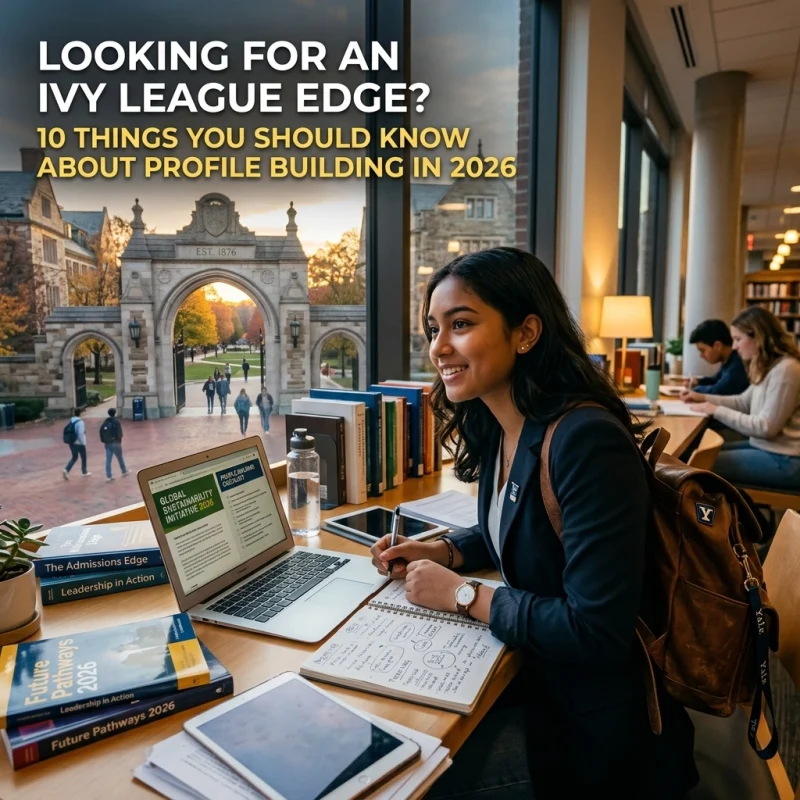
Let’s be real: it’s March 2026, and the Ivy League admissions landscape looks a lot more like a high-stakes chess match than a standard application process. If you’re a parent or a student aiming for the hallowed halls of Harvard, Yale, or Princeton, you’ve probably noticed that the "old rules" don't apply anymore.
With acceptance rates hovering at historic lows (we’re talking sub-5% for some schools), having a 4.0 GPA and a collection of participation trophies is like bringing a toothpick to a swordfight. At STAR Academy, we’ve seen the shift firsthand. The question isn't just about how to get in; it's about how to stand out in a sea of "perfect" applicants.
If you want the edge, you need to rethink your strategy. Here are the 10 things you absolutely need to know about profile building in 2026.
1. Kill the "Well-Rounded" Myth (Be "Angular" Instead)
For decades, parents were told their kids needed to be "well-rounded." You know the drill: piano lessons, varsity soccer, three bake sales, and a part-time job at the library. In 2026, being well-rounded makes you invisible.
Top-tier universities aren't looking for a well-rounded student; they are looking to build a well-rounded class. To get noticed, you need to be angular. An angular student has a "spike": a deep, narrow, and incredibly sharp focus in one specific area. Whether it's quantum computing, 17th-century French literature, or community-based urban gardening, your goal is to be the absolute best at that one thing.

2. Prioritize IB Diploma Program Preparation
The debate between AP and IB is effectively over for those targeting the Ivy League. While AP courses are rigorous, the IB Diploma Program is increasingly seen as the gold standard for global university readiness. Why? Because the IB doesn't just test what you know; it tests how you think.
Admissions officers love the Extended Essay (EE) and Theory of Knowledge (TOK) because they mirror the intensity of university-level research. If you’re looking for IB diploma program preparation, you need to start early. At STAR Academy, we focus on helping students master the IB framework so they can demonstrate the high-level critical thinking that elite schools crave.
3. Intellectual Curiosity is Your Greatest Asset
In a world where AI can write a standard essay in five seconds, admissions officers are hunting for something AI can't faked: genuine intellectual curiosity.
This goes beyond getting an 'A' in chemistry. It’s about what you do when the bell rings. Did you start a research project on carbon sequestration? Did you reach out to a professor at a local university to discuss their latest paper? Intellectual curiosity is about the "why" behind the "what." It shows that you aren't just a grade-chaser, but a lifelong learner who will contribute to the academic vibrancy of a campus.
4. Leadership Must Have Measurable Impact
"President of the Chess Club" is a title. "Increased Chess Club membership by 40% and secured funding for a city-wide tournament" is leadership impact.
When building your profile, stop collecting titles and start documenting results. The Ivy League wants to see that you can move the needle. Whether it’s in your community, your school, or an international organization, your extracurricular activities for university applications should be backed by numbers, stories of growth, and tangible change.
5. The "Spike" Must Be Authentic
You can’t manufacture a passion. Admissions officers are professional "BS-detectors." If a student who hates math suddenly joins three math competitions in Grade 11, it looks exactly like what it is: profile padding.
Your spike should grow naturally from your interests. Our role at STAR Academy is to act as a lighthouse, guiding students to discover where their natural talents meet global needs. When a passion is authentic, the "work" of profile building doesn't feel like work: it feels like an obsession. And obsession is what wins Ivy League spots.

6. Master the Art of the Narrative
In 2026, your application isn't just a folder; it’s a story. Every piece of your profile: from your teacher recommendations to your supplemental essays: should point toward a central theme.
How to build a profile for Ivy League success often comes down to this: can the admissions officer summarize "who you are" in a single sentence?
- “The linguist who uses AI to preserve indigenous languages.”
- “The social entrepreneur who redesigned local food bank logistics.”
If they can’t summarize you, they can’t advocate for you in the committee room.
7. Strategic School Research
Applying to all eight Ivies is a rookie mistake. Each school has a distinct culture and institutional priority. Brown values the "Open Curriculum" and independence; Dartmouth loves its close-knit, outdoorsy community; Penn is all about pre-professional impact.
In 2026, "fit" is more important than "prestige." You need to demonstrate through your essays that you understand the specific DNA of the school. If your essay for Columbia could be swapped with your essay for Yale just by changing the names, you’ve already lost. Check out Our Method to see how we help students align their unique profiles with specific university cultures.
8. The "Secret Sauce": Exceptional Recommendations
Most letters of recommendation are "fine." "Johnny is a hard worker and a delight in class." That letter gets Johnny rejected.
The letters that get students into the Ivy League are the ones that provide specific anecdotes of intellectual bravery or character. You need to build relationships with your teachers and mentors years before you ask for that letter. They need to see you fail, pivot, and succeed. They should be able to speak to your "spike" with as much enthusiasm as you do.
9. Build a Balanced (but Ambitious) List
We see it all the time: a student with an incredible profile who only applies to the Top 10 schools and ends up with zero options. Even with the best profile building, the Ivies are a "reach" for everyone.
A smart 2026 strategy involves a "Diamond" list:
- The Tip: 2-3 Ivy/Elite Reach schools.
- The Middle: 4-5 Target schools where your profile is a strong match.
- The Base: 2-3 Likely schools that you would actually be happy to attend.
10. Start the "Long Game" Early
Profile building isn't something you do in the summer before Grade 12. It’s a multi-year journey. The most successful Ivy League candidates we work with at STAR Academy start thinking about their "spike" in Grade 9 or 10.
This doesn't mean you should be stressed for four years. It means you should be intentional for four years. By starting early, you have time to explore, fail, and eventually double down on the things that truly matter. Whether it's mastering language skills or excelling in advanced math, the foundations take time to build.

Final Thoughts: Beyond the Acceptance Letter
At the end of the day, building an "Ivy League profile" shouldn't just be about getting a thick envelope (or, these days, a fancy email). It should be about becoming a more capable, curious, and impactful human being.
When you focus on real intellectual growth and meaningful contribution, the Ivy League acceptance becomes a byproduct of your excellence, not the sole definition of it.
Ready to start building your edge? At STAR Academy, we don’t just offer counseling; we provide a roadmap for long-term success. From academic coaching to strategic application planning, we’re here to be your partner in this journey.
Contact STAR Academy today to schedule a consultation and see how we can help your child find their "spike."
Related Reading:
- Why the IB Diploma is the ultimate prep for elite colleges.
- How to choose extracurriculars that actually matter in 2026.
- Read our Testimonials from students who made the leap.