

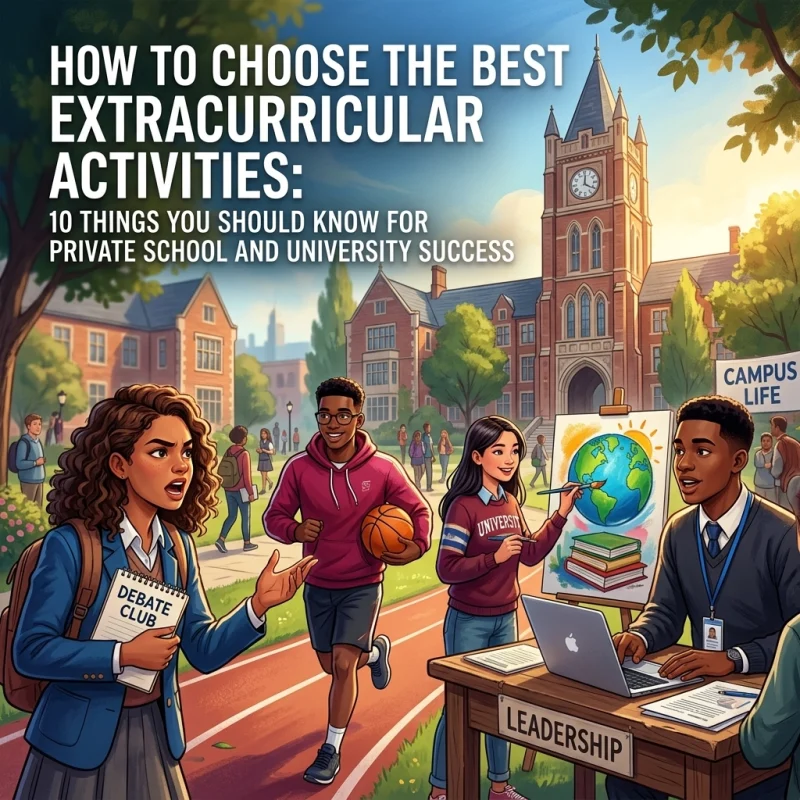
In the current 2026 admissions landscape, the "perfect" student profile has evolved. If you are a parent of a student in grades 6 through 12, you already know that high grades and top-tier test scores are no longer the finish line: they are simply the entry fee. Whether you are aiming for a prestigious local private school or looking toward an Ivy League future, your child’s extracurricular profile is the "lighthouse" that guides admissions officers through a sea of identical applications.
At STAR Academy, we believe that extracurricular activities are not just boxes to be checked; they are a canvas for your child’s character, leadership, and intellectual curiosity. As we navigate the 2026 application cycle, here are the 10 critical things you need to know to build a profile that stands out.
1. Depth Always Beats Breadth (The End of the "Joiner" Era)
Gone are the days when a list of 15 different clubs was the key to success. In 2026, university admissions officers: particularly at Ivy League and elite institutions: are looking for a "spike" rather than a perfectly rounded circle.
Research shows that while private school students often list more activities on average, the most successful candidates are those who demonstrate a deep, sustained commitment to two or three core areas. At STAR Academy, we encourage students to find their "anchor" activities early: ideally by Grade 9: and stick with them. This longevity signals reliability and true interest, rather than a frantic attempt at "resume building" in Grade 11.
2. Prioritize Authentic Passion over "Strategic" Padding
Admissions officers have a high-tuned "authenticity radar." If your child joins the debate team simply because it "looks good," their lack of genuine engagement will show in their essays and interviews.
The best extracurricular activities for university applications are those that your child would do even if no one was watching. When a student is authentically passionate about a project: be it coding, competitive linguistics, or environmental advocacy: their natural enthusiasm translates into a more compelling narrative. Our academic coaching focuses on identifying these intrinsic motivators to ensure the student's profile feels cohesive and real.

3. Leadership is About Impact, Not Just Titles
Being the "President" of a club is a title; leading a club to double its membership or launch a new community initiative is an achievement. For 2026 admissions, leadership is measured by the tangible impact a student has on their community.
We advise our students to look for "gaps." Is there a problem in your school that needs solving? Is there a community need that isn't being met? Taking the initiative to start something: a "passion project": is the gold standard for Ivy League profile building. It demonstrates social resilience and the ability to motivate others.
4. Align Activities with Academic Goals
If your child intends to major in a STEM field, their extracurriculars should reflect that intellectual curiosity. Participation in Math Leagues, Science Olympiads, or independent research projects provides the "proof of concept" for their intended major.
However, this doesn't mean they should only do STEM. At STAR Academy, we use our method to help students find "bridge" activities: for example, a student interested in biology who also volunteers at a local community garden, combining scientific interest with community service.
5. The Role of Tangible Outcomes
In a world where everyone "participates," the student who "produces" wins. This is particularly true for private school application consulting. Admissions committees at top-tier private schools want to see that a student can take a project from conception to completion.
This could look like:
- Publishing an article in a recognized journal.
- Winning a regional or national award in a competition.
- Developing an app that has active users.
- Organizing a fundraising event that met a specific financial goal.
These outcomes provide concrete evidence of a student's competency and drive. However, note, it would a grave mistake if you decide to buy the projects and results for your child instead of giving them the support, space and opportunities to accomplish themselves. Admission officers can see through which projects and magazines actually carry real value, and which ones you simply need to pay to gain access. Furthermore, if someone else did the projects for your child, how would you think your child might perform on the college application essay or interview process?
6. Don’t Overlook the "Soft" Skills
The most valuable extracurriculars are those that build teamwork, leadership, and social resilience. Competitive sports and the performing arts are excellent for this. They teach students how to handle failure, how to work within a team dynamic, and how to manage time under pressure.
Even if your child doesn't plan to play NCAA sports or pursue a BFA, the "social grit" learned in the theater or on the field is highly prized by admissions officers who want to know how a student will contribute to their campus culture.

7. Leverage Your School’s Resources Wisely
Private schools typically offer a massive array of specialized clubs and elite sports. Before looking for external opportunities, students should maximize what is available at their doorstep.
Engaging deeply with school-based activities also allows for stronger relationships with teachers and coaches, which leads to more personalized and enthusiastic letters of recommendation. If you are currently in the process of choosing a school, our school applications consulting can help you identify which institutions offer the specific extracurricular ecosystems that will best support your child's growth.
8. Start Early (But Allow for Evolution)
For parents of students in grades 6-8, the goal should be exploration. Middle school is the time to try everything: French club, robotics, soccer, and jazz band.
As they transition into Grade 9, the focus should shift from exploration to specialization. At STAR Academy, we emphasize that while it is okay for interests to evolve, the "habit" of excellence should be consistent. Transitioning from one activity to another is fine, provided the student is moving toward a deeper interest, not just quitting because things got difficult.
9. Factor in Mental Health and Balance
Rigorous academic loads combined with high-level extracurriculars can lead to burnout. We maintain a tone of calm reassurance at STAR Academy: more is not always better. A stressed, exhausted student cannot perform at their best in any arena.
Choose activities that also serve as an outlet. For some, this is physical exercise; for others, it's a creative pursuit like photography or music. A balanced profile is a sustainable profile. You can see how our students have managed this balance in our testimonials.
10. Digital Presence and Global Reach in 2026
In 2026, a student’s "extracurriculars" are no longer limited by geography. Online platforms allow students to take specialized courses, join global hackathons, or tutor students halfway across the world.
For those aiming for an Ivy League edge, demonstrating a global perspective through digital collaboration is a significant advantage. Whether it’s mastering a language through our language services or participating in international math competitions via our math programs, the ability to operate in a global, digital-first environment is essential.

The STAR Academy Approach to Profile Building
At STAR Academy, we don't believe in superficial packaging or "quick-win" tactics. We believe in building real, long-term competitiveness. Our approach to extracurricular selection is methodical and visionary. We act as a "lighthouse" for our students, providing the structured, logical solutions they need to navigate the complexities of 2026 admissions.
Building a profile for the Ivy League or a top-tier private school is a marathon, not a sprint. It requires integrity, foresight, and a commitment to excellence.
Are you ready to build a profile that truly shines?
Whether you are just starting the journey in middle school or are fine-tuning an application for next year, we are here to provide the expert guidance your family needs.
- Discover our method: Learn how we help students excel.
- Get in touch: Contact STAR Academy today to schedule a consultation and begin crafting your child’s path to success.